




 Aug 19, 2026
 View:235
Acrylic markers have exploded in popularity over the past decade, moving from a niche craft supply to a staple in every artist's toolkit, DIY enthusiast's workshop, and even professional design studios. Unlike traditional alcohol or water-based markers, an acrylic marker delivers actual acrylic paint—pigment suspended in an acrylic polymer emulsion—through a pen-style applicator. This means the ink is opaque, layerable, waterproof when dry, and capable of adhering to almost any surface, from paper and canvas to glass, stone, wood, and metal.
But not all acrylic markers are created equal. The market ranges from cheap craft-store pens that clog and dry out after a few uses, to professional-grade liquid acrylic marker systems that deliver consistent, vibrant color for thousands of strokes. This guide breaks down exactly what makes the best acrylic markers, how to evaluate the key features, which tip types suit which tasks, and how acrylic markers compare to other marker technologies. Whether someone is a hobbyist looking for their first set or a buyer sourcing wholesale marker inventory, the information here provides a clear framework for making an informed decision.
Key Takeaways
Pigment, not dye. The best acrylic markers use pigment-based ink, which is opaque, fade-resistant, and waterproof when dry—unlike dye-based alcohol markers that bleed and fade.
Liquid flow is superior. A liquid acrylic marker with a direct-fill reservoir delivers more consistent ink flow and longer life than traditional fiber-core markers.
Tip type determines use case. Fine round tips for detail, brush tips for calligraphy and broad strokes, chisel tips for filling—dual-tip pens offer the most versatility.
Surface versatility is the big advantage. Acrylic markers work on paper, canvas, wood, stone, glass, ceramic, metal, plastic, and fabric—no other marker type matches this range.
Color count matters less than pigment quality. A 24-color set with high-pigment, lightfast ink outperforms a 60-color set with thin, washed-out color.
What Is an Acrylic Marker, Exactly?
To understand what makes the best acrylic markers, it helps to start with the ink itself. Acrylic paint is a fast-drying medium composed of pigment particles suspended in an acrylic polymer emulsion, along with water, plasticizers, and stabilizers [source]. When applied, the water evaporates and the acrylic polymer particles fuse together, forming a flexible, waterproof, and permanent film. This is fundamentally different from alcohol-based markers, which use dye dissolved in alcohol solvent that soaks into paper and evaporates without forming a protective film.
An acrylic marker packages this paint in a pen body with a valve or fiber-feed system that delivers the ink to a nib on demand. The user presses or shakes the pen to saturate the tip, then draws normally. Because the ink is paint rather than dye, it sits on top of the surface rather than soaking in. This is why acrylic marker artwork has a slightly raised, tactile quality and why the colors can be layered—each dried layer becomes a physical barrier that the next layer sits on top of.
The defining characteristics of acrylic marker ink are:
Opaque coverage: Pigment-based ink covers dark surfaces and previous layers, unlike translucent dye inks.
Waterproof when dry: Once the water carrier evaporates (typically 1–5 minutes), the paint film resists water and smudging.
Water-cleanup while wet: Before drying, excess paint can be removed with a damp cloth or brush—useful for corrections and blending.
Multi-surface adhesion: The acrylic polymer binder sticks to porous and non-porous materials alike.
Flexible film: The dried paint layer is slightly elastic, so it resists cracking on flexible surfaces like fabric or thin plastic.
Traditional vs. Liquid Acrylic Marker: What Is the Difference?
One of the most important distinctions in the acrylic marker market is between traditional fiber-core markers and the newer liquid acrylic marker design. This difference significantly impacts performance, ink capacity, and user experience.
Traditional Fiber-Core Acrylic Markers
In a traditional acrylic marker, the ink is stored in a saturated cotton or polyester fiber core inside the barrel. The nib draws ink from this core via capillary action. This is the same basic design used in most permanent markers and highlighters. The advantages are low manufacturing cost and simple construction. The disadvantages are that ink flow can become inconsistent as the core dries out, the total ink volume is limited by how much the fiber can absorb, and the marker can feel "dry" long before all the ink is actually consumed.
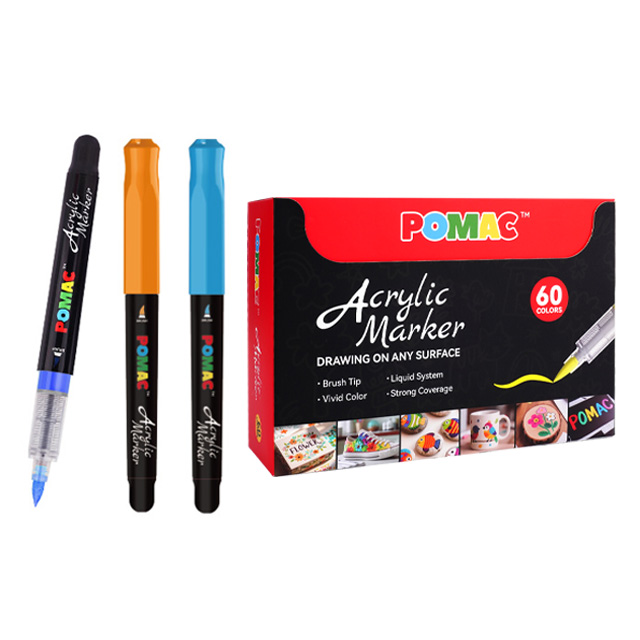
Liquid Acrylic Markers (Direct-Fill / Straight-Liquid)
A liquid acrylic marker stores the paint as free liquid in a reservoir chamber, separated from the nib by a valve mechanism. When the user presses the tip down (or shakes the pen, depending on design), the valve opens and liquid ink flows directly to the nib. This "intelligent ink control" system offers several important advantages:
Consistent flow: Liquid ink feeds the nib evenly, eliminating the "dry start" problem common with fiber-core markers.
Larger ink capacity: A liquid reservoir holds significantly more ink than a saturated fiber core—often 120% or more by volume.
Better shelf life: Because the ink is sealed in a liquid chamber rather than exposed to air in a fiber core, liquid acrylic markers resist drying out during storage.
Visible ink level: Many liquid marker designs use transparent barrels, so the user can see how much ink remains.
Vertical storage tolerance: Liquid markers can often be stored tip-up or tip-down without affecting performance, whereas fiber-core markers prefer horizontal storage.
For these reasons, the best acrylic markers on the market today increasingly use the liquid direct-fill design. It is the technology preferred by professional artists and is the standard in higher-end product lines.
| Feature | Traditional Fiber-Core | Liquid Acrylic Marker |
|---|---|---|
| Ink storage | Saturated fiber core | Free liquid in sealed reservoir |
| Ink capacity | Standard (limited by fiber absorbency) | Up to 120%+ more ink volume |
| Flow consistency | Can be uneven; dry starts common | Consistent via valve control |
| Shelf life / anti-dry | Prone to drying if cap is loose | Better sealed; resists drying |
| Ink level visibility | Usually opaque barrel; cannot see | Transparent barrel often included |
| Price point | Lower | Higher (premium segment) |
| Best for | Casual use, kids, budget buyers | Artists, professionals, high-volume use |
Tip (Nib) Types: Choosing the Right Point for the Job
The nib is the part of the acrylic marker that touches the surface, and its shape and material directly determine what kind of marks the pen can make. The best marker sets offer a range of tip types or dual-tip designs that cover multiple uses in one pen.
Fine Round Tip
The most common tip type, a fine round tip typically produces a line width of 0.7mm to 2mm. It is ideal for outlining, detail work, hand lettering, and writing. Fiber round tips are durable and produce consistent line width regardless of pressure. This is the default tip for general-purpose marker sets.
Brush Tip
A brush tip is made from flexible synthetic fibers (often nylon or POM) that taper to a point. It responds to pressure—light pressure gives a thin line, heavy pressure gives a broad stroke. Brush tips are favored by calligraphers, illustrators, and artists who want variable line weight and a more natural, brush-like feel. They are excellent for blending, shading, and filling medium-sized areas. The downside is that brush tips wear faster than hard fiber tips with heavy use.
Chisel / Broad Tip
A chisel tip has a flat, angled edge that can produce both thin lines (using the corner) and broad strokes up to 5–15mm wide (using the flat edge). It is the most efficient tip for filling large areas, creating bold headlines, and covering backgrounds. Chisel tips are common in signage and poster-making applications.
Dual-Tip Design
Many of the best marker products combine two tip types in a single pen—typically a fine round tip on one end and a brush or chisel tip on the other. This dual-tip design doubles the versatility of each pen and reduces the number of pens needed in a set. For example, a dual-tip acrylic marker with a 0.7mm fine tip and a flexible brush tip handles both detailed outlining and broad color filling in one instrument.
| Tip Type | Line Width | Best For | Durability |
|---|---|---|---|
| Fine Round | 0.7–2 mm | Detail, outlining, writing, hand lettering | High |
| Brush | 1–6 mm (variable) | Calligraphy, illustration, shading, blending | Medium (wears with heavy use) |
| Chisel / Broad | 2–15 mm | Filling large areas, signage, bold lettering | High |
| Dual-Tip (Fine + Brush) | 0.7–6 mm | All-purpose; detail + broad in one pen | Medium-High |
Color Range and Pigment Quality
Color selection is often the first thing buyers notice about a marker set, but pigment quality is what ultimately determines whether the artwork looks professional or amateurish. The best acrylic markers use high-concentration pigment loads that deliver vibrant, opaque color in a single pass, rather than thin, streaky color that requires multiple layers.
Set Sizes
Acrylic marker sets typically come in 12, 24, 36, or 48 color configurations. A 12-color set is suitable for beginners or simple crafts. A 24-color set covers most general illustration and craft needs. A 36 or 48-color set provides the full spectrum, including skin tones, metallics, pastels, and earth tones that professional illustrators and designers require. For wholesale or private-label buyers, offering multiple set sizes allows customers to choose based on their needs and budget.
What to Look for in Pigment Quality
Opacity: High-quality marker ink should cover black or dark surfaces in one or two passes. If the underlying surface shows through significantly, the pigment load is too low.
Lightfastness: Pigment-based inks resist fading from UV light far better than dye-based inks. The best markers use artist-grade pigments rated for lightfastness, ensuring artwork retains its color for years.
Color consistency: Colors should match across pens in the same set and across production batches. Inconsistent color is a sign of poor quality control.
Blendability: While wet, high-quality marker colors should blend smoothly without becoming muddy. Poor-quality pigments may separate or streak when blended.
Non-toxic formulation: The best markers conform to safety standards such as ASTM D-4236 and EN71, making them safe for use by children and in educational settings.
Surface Compatibility: What Can Acrylic Markers Draw On?
The single biggest advantage of an acrylic marker over any other marker type is its ability to work on virtually any surface. This versatility comes from the acrylic polymer binder, which forms an adhesive film that grips both porous and non-porous materials. Below is a breakdown of common surfaces and tips for getting the best results on each.
| Surface | Compatibility | Tips |
|---|---|---|
| Paper / Cardstock | Excellent | Use heavyweight paper (160gsm+) to prevent warping; no bleed-through |
| Canvas | Excellent | Prime canvas first for best adhesion; layer colors for depth |
| Wood | Excellent | Sand smooth and optionally seal before drawing; grain may absorb more ink |
| Stone / Rocks | Excellent | Wash and dry stones first; seal with clear varnish after drying for outdoor use |
| Glass | Good | Clean with alcohol first; cured paint is permanent but can be scraped off |
| Ceramic | Good | Clean surface thoroughly; oven-cure for dishwasher-safe results |
| Metal | Good | Remove rust and grease; primer helps adhesion on smooth metal |
| Plastic | Good | Lightly sand glossy plastic; thin layers work better than thick coats |
| Fabric / Textiles | Good | Place cardboard behind; heat-set with iron after drying; wash cold |
| Leather | Moderate | Clean and deglaze first; thin layers work better than thick coats |
Acrylic vs. Oil-Based vs. Alcohol-Based Markers: A Comparison
Understanding how acrylic markers compare to other marker technologies helps buyers choose the right tool for their specific application. Each type has distinct strengths and weaknesses.
| Characteristic | Acrylic Marker | Oil-Based Marker | Alcohol-Based Marker |
|---|---|---|---|
| Ink type | Pigment in acrylic emulsion | Dye in oil solvent | Dye in alcohol solvent |
| Opacity | Opaque (covers dark surfaces) | Mostly opaque | Translucent (bleeds through) |
| Waterproof when dry | Yes | Yes | Yes (re-activated by alcohol) |
| Surface range | Virtually all surfaces | Most surfaces | Primarily paper / coated |
| Blendability | Short wet window (1–5 min) | Slow drying; easy to blend | Very fast; feather blending |
| Layering | Excellent (opaque layers) | Good | Limited (darkens/muddy) |
| Odor | Mild (water-based) | Strong (xylene/oil) | Moderate (alcohol) |
| Bleed-through | Minimal (sits on surface) | Minimal | Significant (soaks in) |
| Fade resistance | High (pigment-based) | Moderate-High | Low-Moderate (dye fades) |
| Best for | Multi-surface art, crafts | Industrial marking, labels | Manga, rendering, paper art |
How to Use and Maintain Acrylic Markers for Longevity
Even the best acrylic markers require proper use and maintenance to deliver maximum lifespan and consistent performance. Following these simple guidelines significantly extends the life of any marker set.
Priming a New Marker
Most acrylic markers (especially liquid acrylic marker designs) require priming before first use. Shake the pen vigorously for 10–15 seconds to mix the pigment, then press the tip straight down on a scrap surface for 2–3 seconds. Release and wait for the ink to saturate the tip. Repeat until the tip is fully saturated and ink flows evenly. This process mixes settled pigment and activates the valve system.
During Use
Recap immediately after each use—even short exposures to air can dry the tip.
If ink flow slows, gently press the tip on scrap paper for 1–2 seconds to recharge it.
Avoid using excessive pressure, which can damage fiber tips and cause them to fray.
For blending, work quickly while the paint is wet—acrylic dries in 1–5 minutes depending on layer thickness and humidity.
Shake pens periodically during long sessions to keep pigment evenly suspended.
Storage
Store at room temperature (15–25°C / 59–77°F). Avoid extreme heat, which can dry out ink or cause pressure buildup.
Keep away from direct sunlight, which can fade pigment colors over time.
Traditional fiber-core markers should be stored horizontally to keep both tips evenly saturated. Liquid acrylic markers can usually be stored in any orientation—check the manufacturer's instructions.
Always ensure caps are fully clicked into place before storage.
Reviving a Dried-Out Tip
If a tip has dried and will not flow, try these steps in order: (1) Press the tip firmly on scrap paper for 5 seconds to force ink through; (2) Remove the tip with pliers and soak it in warm (not hot) water for 5 minutes, then reinsert and prime; (3) For liquid markers, shake vigorously and press the valve mechanism several times to restart flow. If the ink reservoir itself has dried out, the marker cannot be revived and should be replaced.
Looking for a Reliable Acrylic Marker Manufacturer?
Snowhite has over 30 years of experience manufacturing professional acrylic markers, including advanced liquid acrylic marker systems with intelligent ink control. We offer 24/36/48-color sets, dual-tip designs, private label, and wholesale options for global buyers.
Request a Free Quote →OEM / ODM available · Custom color sets · Non-toxic ASTM D-4236 compliant · Global shipping
Conclusion
The best acrylic markers combine high-pigment, lightfast ink with a reliable delivery system and durable tips. For most users, a liquid acrylic marker with intelligent ink control represents the top tier of the category—it offers consistent flow, larger ink capacity, and better shelf life than traditional fiber-core designs. Dual-tip pens (fine round + brush) provide the greatest versatility, while 24 to 48 color sets cover the needs of everyone from hobbyists to professional illustrators.
What sets acrylic markers apart from all other marker types is their unmatched surface versatility. Whether drawing on paper, canvas, wood, stone, glass, ceramic, metal, or fabric, a quality acrylic marker delivers opaque, waterproof, permanent results that no alcohol or water-based marker can match. This versatility, combined with water-cleanup while wet and mild odor, makes acrylic markers the most practical all-around marker available today.
For businesses sourcing acrylic markers for resale or private label, partnering with an experienced marker manufacturer that controls its own ink formulation, tip production, and quality assurance ensures consistent product quality and reliable supply. Snowhite, with over three decades of writing instrument manufacturing expertise, produces a full range of traditional and liquid marker products designed to meet the standards of both retail consumers and professional markets.
Frequently Asked Questions
Q: What is the difference between acrylic markers and regular markers?
A: Acrylic markers use pigment-based acrylic paint that becomes waterproof and permanent when dry, and works on nearly any surface. Regular markers (alcohol or water-based) use dye-based ink that bleeds through paper, fades faster, and only performs well on paper.
Q: What surfaces can acrylic markers be used on?
A: Acrylic markers work on paper, canvas, wood, stone, glass, ceramic, metal, plastic, fabric, and leather. The paint adheres to both porous and non-porous surfaces, making them the most versatile marker type available.
Q: Are acrylic markers waterproof?
A: Yes, once fully dry (typically 1–5 minutes depending on layer thickness), acrylic marker ink is waterproof and smudge-resistant. While still wet, it can be blended or cleaned with water.
Q: What is a liquid acrylic marker?
A: A liquid acrylic marker uses a direct-fill (straight-liquid) ink reservoir with a valve mechanism instead of a saturated fiber core. This design delivers more consistent ink flow, larger ink capacity (often 120%+), and better resistance to drying out.
Q: How do you prevent acrylic markers from drying out?
A: Always replace the cap immediately after use, store markers at room temperature away from sunlight, and avoid leaving them in high heat. If a tip dries, remove it and soak in warm water for a few minutes, or gently press the tip on scrap paper to restart ink flow.
Q: Can you blend colors with acrylic markers?
A: Yes, but the window is short. Acrylic markers dry in 1–5 minutes, so blending must be done while the paint is still wet. Lay down two adjacent colors and quickly overlap or use a wet brush to merge them. Once dry, acrylic paint is permanent and cannot be re-blended.
Q: How many colors do I need?
A: A 12-color set is sufficient for basic crafts and beginners. A 24-color set covers most general illustration needs. Professional artists and designers typically prefer 36 or 48-color sets for the full spectrum including skin tones, metallics, and earth tones. Quality of pigment matters more than sheer color count.
Q: Are acrylic markers safe for children?
A: Quality acrylic markers use water-based, non-toxic ink that conforms to safety standards like ASTM D-4236 and EN71. They are generally safe for children under adult supervision. However, they are not intended for use on skin or as body paint, and caps should be kept away from very young children due to choking hazard.




View More(Total0)Comment lists