




Pros and Cons of Using Fine Point Acrylic Paint Markers: The Complete Guide
 Jun 12, 2026|
 View:399
Why this matters: Fine point acrylic paint markers have become one of the most popular tools for artists, crafters, teachers, and hobbyists worldwide. But do they suit every project? This guide breaks down every advantage and limitation in plain language — so anyone from a first-time buyer to a seasoned product sourcer can make a truly confident choice.
Key Takeaways
Fine point acrylic paint markers deliver precision lines typically between 0.7mm and 1mm — ideal for detail work, lettering, and outlines.
Their water-based, opaque ink adheres to canvas, glass, ceramic, wood, stone, fabric, and more.
Major advantages include vibrant color, multi-surface compatibility, quick drying, and low-odor formulas meeting international safety standards.
Key drawbacks include susceptibility to tip wear on rough surfaces, the need to prime before use, and limited coverage compared to broader tips.
Knowing when a fine point versus another tip size is appropriate significantly improves results.
Quality varies considerably across manufacturers — tip durability, ink flow, and pigment concentration all matter.
What Are Fine Point Acrylic Paint Markers?
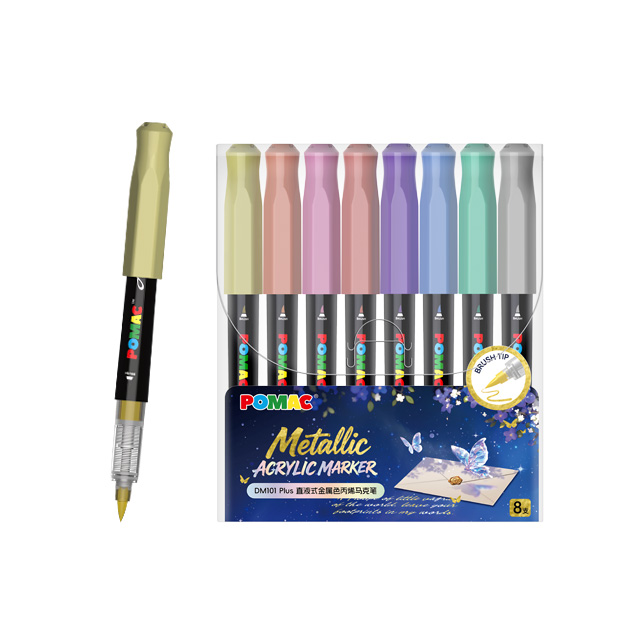
Acrylic paint markers are pen-style tools filled with pigment-based acrylic ink rather than traditional dye-based ink. The "fine point" designation refers to the nib size — typically a rigid, fiber-tipped nib ranging from 0.7mm (extra fine) to 1mm (fine). Unlike flexible brush tips, a fine point nib delivers a consistent, controlled line width regardless of how much pressure is applied.
The ink inside is a water-based liquid acrylic: a polymer emulsion that flows smoothly through the nib and dries to a durable, slightly glossy film. Most quality products use a pump-valve or squeeze mechanism that the user activates by pressing the nib against a surface a few times before starting — a step commonly called "priming." Most standard models in the category offer color sets of 24, 36, or 48 shades, with some specialized lines extending to metallic, fluorescent, or pastel variants.
How These Markers Work
Inside a typical fine point acrylic paint marker, there is an ink reservoir (a cotton or sponge-filled barrel), a valve mechanism, and the nib. When the nib is pressed down, the valve opens, allowing ink to flow upward through capillary action. Because acrylic pigment particles are heavier than dye-based inks, shaking the pen before use is important to keep the suspension uniform and prevent separation.
Premium models feature an intelligent ink control system that prevents flooding — a key quality differentiator between professional and economy products. Once the ink dries on a surface, it forms a polymer film that is water-resistant and relatively permanent, particularly on non-porous materials like glass and metal. On porous substrates such as untreated fabric or raw wood, the dried film can still be washed off with effort if done before full cure.
The Pros of Using Fine Point Acrylic Paint Markers
1. Outstanding Precision for Detail Work
The single most cited advantage of these tools is their precision. A rigid 0.7–1mm nib allows clean, repeatable lines that are difficult to achieve with a loaded brush. For tasks such as outlining designs, adding zentangle patterns, lettering on mugs, drawing fine botanical illustrations, or writing on rock art, a fine point acrylic paint marker outperforms virtually every other tool. The user does not need to manage paint viscosity, brush angle, or loading — the pen handles all of that automatically.
2. Wide Surface Compatibility
Unlike standard felt-tip markers, acrylic paint markers are engineered to adhere to a broad range of substrates. Canvas, paper, cardboard, wood, glass, ceramic, terracotta, metal, plastic, leather, stone, and fabric are all commonly cited surfaces. The opaque pigment covers both light and dark backgrounds effectively, which makes these tools particularly useful for projects where standard ink-based markers would be invisible or insufficient.
3. Highly Opaque, Vibrant Color
The pigment-to-binder ratio in acrylic-based markers is typically much higher than in dye-based alternatives. Colors appear vivid and opaque rather than transparent or watery. Even a single pass on dark paper or a painted rock delivers a noticeably bright, clean result. Quality product lines offer 24, 36, or even 48 color options — covering a full spectrum from neutrals to metallics and fluorescents.
4. Fast Drying and Layerable
Water-based acrylic ink dries rapidly — typically within 1–3 minutes under normal conditions. This quick cure time means artists can layer colors without long waits, enabling blending, shading, and correction. Layering is especially useful for rock painting and ceramic decorating, where multiple thin passes build up depth and texture that a single application cannot achieve.
5. Low Odor and Widely Considered Safe
Because these products are water-based rather than solvent-based, they produce very little odor and do not release the volatile organic compounds (VOCs) associated with alcohol-based or oil-based markers. Many formulations comply with ASTM D4236 — the standard practice for labeling art materials for chronic health hazards — and carry an AP (Approved Product) non-toxic certification. According to the U.S. Consumer Product Safety Commission (CPSC), all art materials sold in the United States must comply with labeling requirements under the Labeling of Hazardous Art Materials Act (LHAMA), providing a meaningful layer of consumer protection. This makes these pens suitable for classrooms, homes with children, and indoor craft spaces.
6. Long Shelf Life When Stored Correctly
A properly sealed marker stored horizontally or tip-down can remain usable for one to two years. Unlike tube paints that can dry out after opening, the sealed reservoir protects the ink from air exposure. Some manufacturers use large-capacity reservoirs — equivalent to the content of several standard units — which extends the usable life and reduces replacement frequency significantly.
7. Excellent for Multi-Surface Projects
Craft artists and DIY hobbyists value the fact that a single set of fine point acrylic paint markers can handle an entire mixed-material project: sketching the design on paper, applying detail on wood, then finishing with precise work on glass or ceramic. This versatility reduces the need to purchase and manage separate media for each substrate.
8. Easy to Use — No Special Skills Required
Compared to a brush and palette, these pens require almost no setup. There is no mixing, no palette cleaning, no loading, and no risk of dripping. The user simply shakes, primes, and draws. This accessibility makes them popular with beginners, children (when using AP-certified products), teachers, and hobbyists who want reliable results without a steep learning curve.
Advantages at a Glance
Precise, consistent line width (0.7–1mm)
Works on 15+ different surface types
Opaque ink covers dark backgrounds
Quick drying — enables layering
Low odor, water-based formula
ASTM D4236 / AP certification available
Easy to use with minimal preparation
Long shelf life with proper storage
Wide color range (up to 48+ colors)
Disadvantages at a Glance
Tips wear faster on rough/textured surfaces
Requires priming before first use
Limited fill coverage vs. broad tips
Ink can clog if left uncapped
Pigment settles — must shake before use
Not efficient for very large fill areas
Quality varies widely by manufacturer
Higher cost than standard felt-tip markers
The Cons of Using Fine Point Acrylic Paint Markers
1. Tip Wear on Rough or Abrasive Surfaces
The most commonly reported disadvantage is nib degradation. Fine point nibs are made from compressed fiber or felt, and when used on abrasive surfaces — coarse stone, rough concrete, unglazed terracotta, or sandpaper — they can fray or flatten after extended use, losing precision. The finer the nib, the more noticeable this becomes. Users who primarily work on smooth substrates such as glass, polished ceramic, or smooth paper will experience far less tip wear than those working on rocks or raw wood.
2. Priming and Activation Required
Unlike a standard pen, most acrylic paint markers require a priming step before first use and sometimes again after long storage. The user shakes the pen, removes the cap, and presses the nib against scrap paper repeatedly until ink flows evenly — a process that takes 10–30 seconds. Products with intelligent ink control systems manage this more smoothly, but the activation step remains a consistent feature of the category and can catch beginners off guard.
3. Limited Fill Coverage Efficiency
A fine point nib — by design — deposits a narrow, precise line. For small lettering or intricate outlines, this is exactly what is needed. But for filling large areas with solid color, a 0.7–1mm tip requires many overlapping strokes, which is time-consuming and can result in visible stroke marks if layers dry between passes. For large fills, artists typically supplement with medium-tip (2–3mm) or chisel-tip variants alongside their fine point tools.
4. Clogging If Left Uncapped
Acrylic ink is polymer-based and begins to dry on contact with air. If one of these pens is left uncapped for even a few minutes, the nib can start to dry and clog. On a 0.7mm or 1mm tip, even a small blockage is proportionally significant. The solution is simple — cap the marker immediately after each use — but it is a habit that inattentive users discover the hard way. Some manufacturers address this issue with retractable-tip designs that minimize accidental air exposure.
5. Pigment Settling in the Reservoir
Because acrylic ink is a pigment suspension rather than a true solution, the pigment particles settle to the bottom of the reservoir during storage. A pen that has not been shaken before use may initially deliver pale, washed-out color until the suspension is re-homogenized. Users who skip the shaking step often feel disappointed with the first few strokes — though this is a fundamental property of pigment-based inks, not a defect.
6. Higher Cost Relative to Basic Markers
Quality fine point acrylic paint markers carry a higher unit cost than standard felt-tip stationery markers. A set of 36 or 48 professional-grade options is a meaningful investment. The price is justified by the ink formulation, tip construction, and surface versatility, but buyers expecting the cost of everyday stationery may be surprised. That said, the per-use cost is typically lower than it appears when factoring in lifespan and the range of surfaces covered.
7. Variable Quality Across Manufacturers
Not all products in this category are created equal. The quality of the nib material, pigment concentration, ink control mechanism, and cap seal all vary significantly between suppliers. A lower-quality option may have a nib that frays after a few uses, ink that bleeds unevenly, or a weak cap seal that allows the product to dry out prematurely. This makes manufacturer selection an important decision, particularly for businesses and resellers sourcing in volume.
Fine Point vs. Other Tip Sizes: Quick Comparison
| Tip Type | Typical Size | Best For | Key Limitation |
|---|---|---|---|
| Extra Fine Point | 0.7mm | Intricate details, small lettering, outlines on small objects | Wears faster; not suitable for large fills |
| Fine Point | 1mm | Detail work, patterns, journaling, mixed-media art | Limited for wide-area coverage |
| Medium Tip | 2–3mm | Filling medium areas, block lettering, general illustration | Less precision for fine details |
| Brush Tip | 1–5mm (flex) | Calligraphy, brushstroke effects, expressive wide strokes | Requires brush technique; variable line width |
| Chisel Tip | 4–8mm | Bold fills, graffiti-style lettering, broad coverage | Too wide for fine detail work |
Surface Compatibility Overview
| Surface | Performance | Notes |
|---|---|---|
| Canvas (primed) | Excellent | Ideal for detail outlines and mixed-media layering |
| Glass & ceramic | Excellent | Opaque result; heat-setting may improve durability |
| Smooth wood | Very good | Sealing the surface first improves coverage |
| Paper & cardboard | Very good | Fast drying; slight bleed on very low-gsm paper |
| Stone & rocks | Good | Opaque result; rough texture accelerates tip wear |
| Fabric | Moderate | Heat-set with iron to improve wash resistance |
| Metal (bare) | Moderate | A light sand or primer coat improves adhesion |
| Coarse concrete | Limited | Rapid tip wear; broad tips are recommended instead |
Who Benefits Most from These Markers?
Practical Tips for Getting the Best Results
Storage and Maintenance
Storing these pens horizontally keeps the ink evenly distributed across the reservoir, reducing the chance of uneven flow during priming. Tip-down storage is recommended when a marker has recently been primed and is in active daily use. Always cap immediately after use, and keep away from direct sunlight and extreme heat, both of which can degrade the ink and soften nib material.
Quick Tip: If a nib feels dry and no ink flows even after shaking and pressing, dip the tip briefly (2–3 seconds) in clean water, then press it on scrap paper. This can rehydrate and reactivate a temporarily dried nib without damaging the pen.
Surface Preparation
On porous surfaces like raw wood or unglazed terracotta, applying a light sealer coat before use significantly improves adhesion and reduces ink spread. On glass and ceramic, cleaning with isopropyl alcohol removes oils and dust, helping the ink bond more reliably. On fabric, stretching the material over a flat, firm surface produces cleaner lines without distortion.
Layering Techniques
Because acrylic ink dries rapidly, layering is straightforward: apply the first color, wait 1–2 minutes, then draw over it. This works best when the under-layer is fully dry, as wet-on-wet application can cause nib contamination. Lighter colors over darker ones demonstrate the true opacity of quality acrylic paint markers — a technique central to rock painting and ceramic art.
Choosing the Right Tip for the Job
Fine point acrylic paint markers are the right choice for small text (below approximately 8mm letter height), intricate patterns, precise outlines, and highly detailed illustrative elements. For backgrounds, large lettering, or bold graphic fills, using a medium or chisel-tip marker from the same product line alongside the fine point delivers a more professional overall result.
Quality Factors to Evaluate When Choosing
| Factor | What to Look For | Why It Matters |
|---|---|---|
| Nib material | Compressed fiber or nylon with reinforced tip | Harder nibs last longer on rough surfaces |
| Ink control system | Pump-valve or intelligent flow control | Prevents flooding; ensures consistent output |
| Pigment concentration | High pigment-to-binder ratio | Delivers opacity and vibrancy in a single pass |
| Cap seal quality | Airtight cap with no visible gaps | Determines shelf life and storage reliability |
| Safety certification | ASTM D4236 / AP non-toxic label | Required for school and children's use; signals professional formulation |
| Reservoir capacity | Larger reservoirs extend usage per unit | Reduces replacement frequency and total cost |
| Color range | 24–48+ colors including metallic and pastel options | Broader palette reduces the need to substitute |
Are Fine Point Acrylic Paint Markers Worth It?
For anyone who regularly works on detail-oriented art, mixed-media crafts, DIY decoration, or educational projects, fine point acrylic paint markers represent a genuinely versatile and efficient investment. Their core strengths — precision, surface versatility, opacity, and safety — outweigh the limitations for the vast majority of use cases. The main drawbacks (tip wear, need to prime, limited fill coverage) are manageable with simple techniques and good storage habits.
The critical variable is product quality. A well-made set from a reputable manufacturer — one that invests in nib construction, ink formulation, and intelligent ink control — will outlast and outperform cheaper alternatives by a significant margin, making the per-use cost lower than the sticker price suggests.
Looking for a Reliable Acrylic Paint Marker Manufacturer?
Snowhite has been developing and manufacturing professional-grade acrylic paint markers for over 30 years. The liquid acrylic marker series — featuring intelligent ink control, fiber and brush tip options, and color sets of up to 48 shades — is available for OEM, ODM, and wholesale partnership. For businesses or brands searching for a dependable acrylic paint markers manufacturer with proven quality and global supply capability, Snowhite is worth a closer look.
Send an Inquiry to SnowhiteFrequently Asked Questions
What is the difference between fine point and extra-fine point acrylic paint markers?
Fine point models use a 1mm nib; extra-fine point versions use a 0.7mm nib. Extra-fine tips provide greater precision for small lettering and intricate details, while fine point tips balance precision with slightly better ink flow on textured surfaces.
Can fine point acrylic paint markers be used on dark surfaces?
Yes. Quality products contain highly pigmented opaque ink that covers dark backgrounds effectively — including black paper, dark wood, and rough stones. White and light-color options are especially popular for writing on dark substrates.
How long do acrylic paint markers last once opened?
When capped properly after each use, most products remain usable for 1–2 years. Horizontal or tip-down storage away from heat keeps the nib primed and extends lifespan.
Are fine point acrylic paint markers permanent and waterproof?
Once fully cured, most water-based products become water-resistant on non-porous surfaces like glass, metal, and ceramic. On fabric, washability varies — always check the product specification for permanence data.
What surfaces work best with fine point acrylic paint markers?
They perform best on smooth, non-porous surfaces such as canvas, glass, ceramic, metal, and sealed wood. Very rough or highly absorbent surfaces accelerate tip wear and can cause uneven coverage.
Do acrylic paint markers need to be shaken before use?
Yes. Shaking before use and pressing the nib to activate ink flow is standard practice. This ensures the pigment is evenly distributed in the reservoir and delivers consistent color from the very first stroke.
Are fine point acrylic paint markers safe for children to use?
Many are formulated to be non-toxic and comply with ASTM D4236 safety labeling requirements. Products carrying an AP certification have been reviewed by a toxicologist and are generally safe for classroom and home use. Always verify the label before handing any art material to children.



View More(Total0)Comment lists